| Entry |
|
| Name |
Calcium signaling pathway
|
| Description |
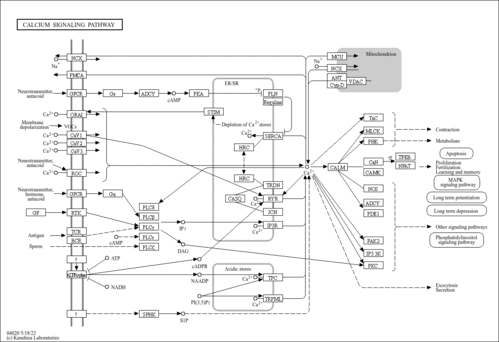
Ca2+ that enters the cell from the outside is a principal source of signal Ca2+. Entry of Ca2+ is driven by the presence of a large electrochemical gradient across the plasma membrane. Cells use this external source of signal Ca2+ by activating various entry channels with widely different properties. The voltage-operated channels (VOCs) are found in excitable cells and generate the rapid Ca2+ fluxes that control fast cellular processes. There are many other Ca2+-entry channels, such as the receptor-operated channels (ROCs), for example the NMDA (N-methyl-D-aspartate) receptors (NMDARs) that respond to glutamate. There also are second-messenger-operated channels (SMOCs) and store-operated channels (SOCs).
The other principal source of Ca2+ for signalling is the internal stores that are located primarily in the endoplasmic/sarcoplasmic reticulum (ER/SR), in which inositol-1,4,5-trisphosphate receptors (IP3Rs) or ryanodine receptors (RYRs) regulate the release of Ca2+. The principal activator of these channels is Ca2+ itself and this process of Ca2+-induced Ca2+ release is central to the mechanism of Ca2+ signalling. Various second messengers or modulators also control the release of Ca2+. IP3, which is generated by pathways using different isoforms of phospholipase C (PLCbeta, delta, epsilon, gamma and zeta), regulates the IP3Rs. Cyclic ADP-ribose (cADPR) releases Ca2+ via RYRs. Nicotinic acid adenine dinucleotide phosphate (NAADP) may activate a distinct Ca2+ release mechanism on separate acidic Ca2+ stores. Ca2+ release via the NAADP-sensitive mechanism may also feedback onto either RYRs or IP3Rs. cADPR and NAADP are generated by CD38. This enzyme might be sensitive to the cellular metabolism, as ATP and NADH inhibit it.
The influx of Ca2+ from the environment or release from internal stores causes a very rapid and dramatic increase in cytoplasmic calcium concentration, which has been widely exploited for signal transduction. Some proteins, such as troponin C (TnC) involved in muscle contraction, directly bind to and sense Ca2+. However, in other cases Ca2+ is sensed through intermediate calcium sensors such as calmodulin (CALM).
|
| Class |
Environmental Information Processing; Signal transduction
 |
| Pathway map |
| Calcium signaling pathway |

  |
| Disease |
| 46,XY disorders of sex development (Disorders in androgen synthesis or action) | | Premature ovarian failure | | Central core disease | | Darier disease | | Brugada syndrome (BRS) | | Hypokalemic periodic paralysis (HypoPP) | | Episodic ataxias | | Acrokeratosis verruciformis | | Waardenburg syndrome (WS) | | Familial or sporadic hemiplegic migraine | | Congenital stationary night blindness (CSNB) | | Familial thoracic aortic aneurysm and dissection (TAAD) | | ABCD syndrome | | Lethal congenital contractural syndrome (LCCS) | | Hirschsprung disease (HD) | | Precocious puberty | | Catecholaminergic polymorphic ventricular tachycardia | | Progressive external ophthalmoplegia (PEO) | | Brody myopathy | | Nonsyndromic congenital nail disorder (NDNC) | | Multi-minicore disease (MmD) |
|
| Other DBs |
|
| Reference |
|
| Authors |
Berridge MJ, Bootman MD, Roderick HL. |
| Title |
Calcium signalling: dynamics, homeostasis and remodelling. |
| Journal |
Nat Rev Mol Cell Biol 4:517-29 (2003) |
| Reference |
|
| Authors |
Berridge MJ, Lipp P, Bootman MD. |
| Title |
The versatility and universality of calcium signalling. |
| Journal |
Nat Rev Mol Cell Biol 1:11-21 (2000) |
| Reference |
|
| Authors |
Wang MC, Dolphin A, Kitmitto A. |
| Title |
L-type voltage-gated calcium channels: understanding function through structure. |
| Journal |
FEBS Lett 564:245-50 (2004) |
| Reference |
|
| Authors |
Ferrier GR, Howlett SE. |
| Title |
Cardiac excitation-contraction coupling: role of membrane potential in regulation of contraction. |
| Journal |
Am J Physiol Heart Circ Physiol 280:H1928-44 (2001) |
| Reference |
|
| Authors |
Keef KD, Hume JR, Zhong J. |
| Title |
Regulation of cardiac and smooth muscle Ca(2+) channels (Ca(V)1.2a,b) by protein kinases. |
| Journal |
Am J Physiol Cell Physiol 281:C1743-56 (2001) |
| Reference |
|
| Authors |
Hell JW, Appleyard SM, Yokoyama CT, Warner C, Catterall WA. |
| Title |
Differential phosphorylation of two size forms of the N-type calcium channel alpha 1 subunit which have different COOH termini. |
| Journal |
J Biol Chem 269:7390-6 (1994) |
| Reference |
|
| Authors |
Yunker AM. |
| Title |
Modulation and pharmacology of low voltage-activated ("T-Type") calcium channels. |
| Journal |
J Bioenerg Biomembr 35:577-98 (2003) |
| Reference |
|
| Authors |
Yakel JL. |
| Title |
Calcineurin regulation of synaptic function: from ion channels to transmitter release and gene transcription. |
| Journal |
Trends Pharmacol Sci 18:124-34 (1997) |
| Reference |
|
| Authors |
Fukunaga K, Miyamoto E. |
| Title |
A working model of CaM kinase II activity in hippocampal long-term potentiation and memory. |
| Journal |
Neurosci Res 38:3-17 (2000) |
| Reference |
|
| Authors |
Della Rocca GJ, van Biesen T, Daaka Y, Luttrell DK, Luttrell LM, Lefkowitz RJ. |
| Title |
Ras-dependent mitogen-activated protein kinase activation by G protein-coupled receptors. Convergence of Gi- and Gq-mediated pathways on calcium/calmodulin, Pyk2, and Src kinase. |
| Journal |
J Biol Chem 272:19125-32 (1997) |
| Reference |
|
| Authors |
Furuichi T, Mikoshiba K. |
| Title |
Inositol 1, 4, 5-trisphosphate receptor-mediated Ca2+ signaling in the brain. |
| Journal |
J Neurochem 64:953-60 (1995) |
| Reference |
|
| Authors |
Bruce JI, Straub SV, Yule DI. |
| Title |
Crosstalk between cAMP and Ca2+ signaling in non-excitable cells. |
| Journal |
Cell Calcium 34:431-44 (2003) |
| Reference |
|
| Authors |
Lee HC, Munshi C, Graeff R. |
| Title |
Structures and activities of cyclic ADP-ribose, NAADP and their metabolic enzymes. |
| Journal |
Mol Cell Biochem 193:89-98 (1999) |
| Reference |
|
| Authors |
Crompton M. |
| Title |
Mitochondrial intermembrane junctional complexes and their role in cell death. |
| Journal |
J Physiol 529 Pt 1:11-21 (2000) |
| Reference |
|
| Authors |
Grewal SS, York RD, Stork PJ. |
| Title |
Extracellular-signal-regulated kinase signalling in neurons. |
| Journal |
Curr Opin Neurobiol 9:544-53 (1999) |
| Reference |
|
| Authors |
Trushin SA, Pennington KN, Carmona EM, Asin S, Savoy DN, Billadeau DD, Paya CV. |
| Title |
Protein kinase Calpha (PKCalpha) acts upstream of PKCtheta to activate IkappaB kinase and NF-kappaB in T lymphocytes. |
| Journal |
Mol Cell Biol 23:7068-81 (2003) |
| Reference |
|
| Authors |
Hutchins JR, Dikovskaya D, Clarke PR. |
| Title |
Regulation of Cdc2/cyclin B activation in Xenopus egg extracts via inhibitory phosphorylation of Cdc25C phosphatase by Ca(2+)/calmodulin-dependent protein [corrected] kinase II. |
| Journal |
Mol Biol Cell 14:4003-14 (2003) |
| Reference |
|
| Authors |
Tornquist K |
| Title |
Sphingosine 1-phosphate, sphingosine kinase and autocrine calcium signalling in thyroid cells. |
| Journal |
Acta Physiol (Oxf) 204:151-7 (2012) |
| Reference |
|
| Authors |
Feske S |
| Title |
Immunodeficiency due to defects in store-operated calcium entry. |
| Journal |
Ann N Y Acad Sci 1238:74-90 (2011) |
| Reference |
|
| Authors |
Giachini FR, Lima VV, Hannan JL, Carneiro FS, Webb RC, Tostes RC |
| Title |
STIM1/Orai1-mediated store-operated Ca2+ entry: the tip of the iceberg. |
| Journal |
Braz J Med Biol Res 44:1080-7 (2011) |
| Reference |
|
| Authors |
Baba Y, Kurosaki T |
| Title |
[Regulation of store-operated calcium entry by STIM1]. |
| Journal |
Seikagaku 80:1123-8 (2008) |
| KO pathway |
|