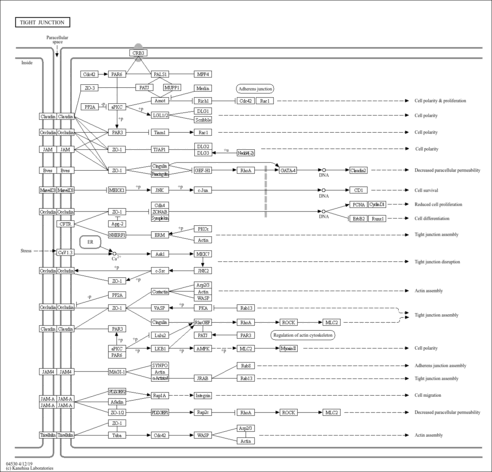
Entry Name Tight junction
Description Tight junctions (TJs) are essential for establishing a selectively permeable barrier to diffusion through the paracellular space between neighboring cells. TJs are composed of at least three types of transmembrane protein -occludin, claudin and junctional adhesion molecules (JAMs)- and a cytoplasmic 'plaque' consisting of many different proteins that form large complexes. These are proposed to be involved in junction assembly, barrier regulation, cell polarity, gene transcription, and other pathways.
Class Cellular Processes; Cellular community - eukaryotesBRITE hierarchy
Pathway map Ortholog table Other DBs Reference Authors Zihni C, Mills C, Matter K, Balda MS
Title Tight junctions: from simple barriers to multifunctional molecular gates.
Journal Reference Authors Martin-Belmonte F, Perez-Moreno M
Title Epithelial cell polarity, stem cells and cancer.
Journal Reference Authors Weber C, Fraemohs L, Dejana E
Title The role of junctional adhesion molecules in vascular inflammation.
Journal Reference Authors Miyoshi J, Takai Y
Title Molecular perspective on tight-junction assembly and epithelial polarity.
Journal Reference Authors Mertens AE, Pegtel DM, Collard JG
Title Tiam1 takes PARt in cell polarity.
Journal Reference Authors Shin K, Fogg VC, Margolis B
Title Tight junctions and cell polarity.
Journal Reference Authors Kooistra MR, Dube N, Bos JL
Title Rap1: a key regulator in cell-cell junction formation.
Journal Reference Authors Gonzalez-Mariscal L, Tapia R, Chamorro D
Title Crosstalk of tight junction components with signaling pathways.
Journal Reference Authors Assemat E, Bazellieres E, Pallesi-Pocachard E, Le Bivic A, Massey-Harroche D
Title Polarity complex proteins.
Journal Reference Authors Iden S, Collard JG
Title Crosstalk between small GTPases and polarity proteins in cell polarization.
Journal Reference Authors Rosse C, Linch M, Kermorgant S, Cameron AJ, Boeckeler K, Parker PJ
Title PKC and the control of localized signal dynamics.
Journal Reference Authors Terry S, Nie M, Matter K, Balda MS
Title Rho signaling and tight junction functions.
Journal Reference Authors Russ PK, Pino CJ, Williams CS, Bader DM, Haselton FR, Chang MS
Title Bves modulates tight junction associated signaling.
Journal Reference Authors Citi S, Spadaro D, Schneider Y, Stutz J, Pulimeno P
Title Regulation of small GTPases at epithelial cell-cell junctions.
Journal Reference Authors Lickert H, Van Campenhout CA
Title Evolution of the Discs large gene family provides new insights into the establishment of apical epithelial polarity and the etiology of mental retardation.
Journal Reference Authors Spadaro D, Tapia R, Pulimeno P, Citi S
Title The control of gene expression and cell proliferation by the epithelial apical junctional complex.
Journal Reference Authors Moleirinho S, Guerrant W, Kissil JL
Title The Angiomotins--from discovery to function.
Journal Reference Authors Rodriguez-Boulan E, Macara IG
Title Organization and execution of the epithelial polarity programme.
Journal Reference Authors Gonzalez-Mariscal L, Dominguez-Calderon A, Raya-Sandino A, Ortega-Olvera JM, Vargas-Sierra O, Martinez-Revollar G
Title Tight junctions and the regulation of gene expression.
Journal Reference Authors Mack NA, Georgiou M
Title The interdependence of the Rho GTPases and apicobasal cell polarity.
Journal Reference Authors Citi S, Guerrera D, Spadaro D, Shah J
Title Epithelial junctions and Rho family GTPases: the zonular signalosome.
Journal Reference Authors Zihni C, Terry SJ
Title RhoGTPase signalling at epithelial tight junctions: Bridging the GAP between polarity and cancer.
Journal Reference Authors Nakano A, Takashima S
Title LKB1 and AMP-activated protein kinase: regulators of cell polarity.
Journal Reference Authors Patrie KM, Drescher AJ, Welihinda A, Mundel P, Margolis B
Title Interaction of two actin-binding proteins, synaptopodin and alpha-actinin-4, with the tight junction protein MAGI-1.
Journal Reference Authors Yamamura R, Nishimura N, Nakatsuji H, Arase S, Sasaki T
Title The interaction of JRAB/MICAL-L2 with Rab8 and Rab13 coordinates the assembly of tight junctions and adherens junctions.
Journal Reference Authors Monteiro AC, Sumagin R, Rankin CR, Leoni G, Mina MJ, Reiter DM, Stehle T, Dermody TS, Schaefer SA, Hall RA, Nusrat A, Parkos CA
Title JAM-A associates with ZO-2, afadin, and PDZ-GEF1 to activate Rap2c and regulate epithelial barrier function.
Journal Related map04810 Regulation of actin cytoskeleton
KO pathway