| Entry |
|
| Name |
Cocaine addiction
|
| Description |
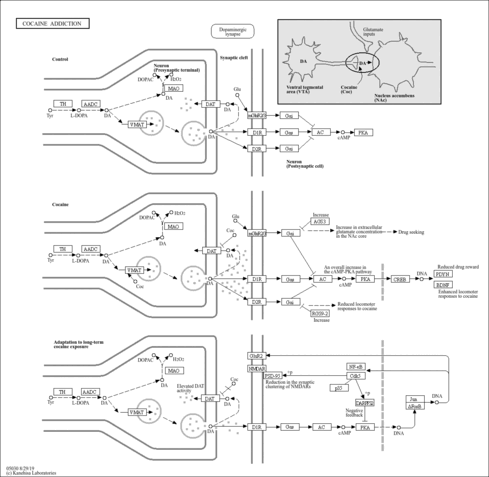
Drug addiction is a chronic, relapsing disorder in which compulsive drug-seeking and drug-taking behavior persists despite serious negative consequences.There is strong evidence that the dopaminergic system that projects from the ventral tegmental area (VTA) of the midbrain to the nucleus accumbens (NAc), and to other forebrain sites, is the major substrate of reward and reinforcement for both natural rewards and addictive drugs. Cocaine binds strongly to the dopamine-reuptake transporter, preventing the reuptake of dopamine into the nerve terminal. Because of this blocking effect, dopamine remains at high concentrations in the synapse and continues to affect adjacent neurons, producing the characteristic cocaine "high." Activated D1 receptor activates the PKA signaling pathway, and this pathway plays a critical role in mediating the behavioral responses to cocaine administration. Cocaine-induced neuroadaptations, including dopamine depletion, may underlie craving and hedonic dysregulation.
|
| Class |
Human Diseases; Substance dependence
 |
| Pathway map |

  |
| Other DBs |
|
| Reference |
|
| Authors |
Ron D, Jurd R |
| Title |
The "ups and downs" of signaling cascades in addiction. |
| Journal |
Sci STKE 2005:re14 (2005) |
| Reference |
|
| Authors |
Cunha-Oliveira T, Rego AC, Oliveira CR |
| Title |
Cellular and molecular mechanisms involved in the neurotoxicity of opioid and psychostimulant drugs. |
| Journal |
Brain Res Rev 58:192-208 (2008) |
| Reference |
|
| Authors |
Chen JC, Chen PC, Chiang YC |
| Title |
Molecular mechanisms of psychostimulant addiction. |
| Journal |
Chang Gung Med J 32:148-54 (2009) |
| Reference |
|
| Authors |
Nestler EJ |
| Title |
Is there a common molecular pathway for addiction? |
| Journal |
Nat Neurosci 8:1445-9 (2005) |
| Reference |
|
| Authors |
Bowers MS, McFarland K, Lake RW, Peterson YK, Lapish CC, Gregory ML, Lanier SM, Kalivas PW |
| Title |
Activator of G protein signaling 3: a gatekeeper of cocaine sensitization and drug seeking. |
| Journal |
Neuron 42:269-81 (2004) |
| Reference |
|
| Authors |
Rahman Z, Schwarz J, Gold SJ, Zachariou V, Wein MN, Choi KH, Kovoor A, Chen CK, DiLeone RJ, Schwarz SC, Selley DE, Sim-Selley LJ, Barrot M, Luedtke RR, Self D, Neve RL, Lester HA, Simon MI, Nestler EJ |
| Title |
RGS9 modulates dopamine signaling in the basal ganglia. |
| Journal |
Neuron 38:941-52 (2003) |
| Reference |
|
| Authors |
Horger BA, Iyasere CA, Berhow MT, Messer CJ, Nestler EJ, Taylor JR |
| Title |
Enhancement of locomotor activity and conditioned reward to cocaine by brain-derived neurotrophic factor. |
| Journal |
J Neurosci 19:4110-22 (1999) |
| Reference |
|
| Authors |
Mash DC, Pablo J, Ouyang Q, Hearn WL, Izenwasser S |
| Title |
Dopamine transport function is elevated in cocaine users. |
| Journal |
J Neurochem 81:292-300 (2002) |
| Reference |
|
| Authors |
McClung CA, Nestler EJ |
| Title |
Regulation of gene expression and cocaine reward by CREB and DeltaFosB. |
| Journal |
Nat Neurosci 6:1208-15 (2003) |
| Reference |
|
| Authors |
McClung CA, Ulery PG, Perrotti LI, Zachariou V, Berton O, Nestler EJ |
| Title |
DeltaFosB: a molecular switch for long-term adaptation in the brain. |
| Journal |
Brain Res Mol Brain Res 132:146-54 (2004) |
| Reference |
|
| Authors |
Ang E, Chen J, Zagouras P, Magna H, Holland J, Schaeffer E, Nestler EJ |
| Title |
Induction of nuclear factor-kappaB in nucleus accumbens by chronic cocaine administration. |
| Journal |
J Neurochem 79:221-4 (2001) |
| Reference |
|
| Authors |
Bibb JA, Chen J, Taylor JR, Svenningsson P, Nishi A, Snyder GL, Yan Z, Sagawa ZK, Ouimet CC, Nairn AC, Nestler EJ, Greengard P |
| Title |
Effects of chronic exposure to cocaine are regulated by the neuronal protein Cdk5. |
| Journal |
Nature 410:376-80 (2001) |
| Reference |
|
| Authors |
Chao J, Nestler EJ |
| Title |
Molecular neurobiology of drug addiction. |
| Journal |
Annu Rev Med 55:113-32 (2004) |
| KO pathway |
|