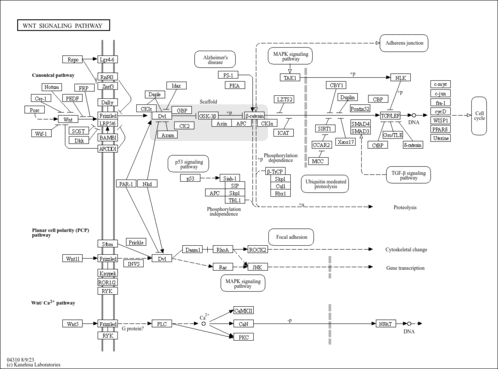
PATHWAY: ko04310 Help
Entry Name Wnt signaling pathway
Description Wnt proteins are secreted morphogens that are required for basic developmental processes, such as cell-fate specification, progenitor-cell proliferation and the control of asymmetric cell division, in many different species and organs. There are at least three different Wnt pathways: the canonical pathway, the planar cell polarity (PCP) pathway and the Wnt/Ca2+ pathway. In the canonical Wnt pathway, the major effect of Wnt ligand binding to its receptor is the stabilization of cytoplasmic beta-catenin through inhibition of the bea-catenin degradation complex. Beta-catenin is then free to enter the nucleus and activate Wnt-regulated genes through its interaction with TCF (T-cell factor) family transcription factors and concomitant recruitment of coactivators. Planar cell polarity (PCP) signaling leads to the activation of the small GTPases RHOA (RAS homologue gene-family member A) and RAC1, which activate the stress kinase JNK (Jun N-terminal kinase) and ROCK (RHO-associated coiled-coil-containing protein kinase 1) and leads to remodelling of the cytoskeleton and changes in cell adhesion and motility. WNT-Ca2+ signalling is mediated through G proteins and phospholipases and leads to transient increases in cytoplasmic free calcium that subsequently activate the kinase PKC (protein kinase C) and CAMKII (calcium calmodulin mediated kinase II) and the phosphatase calcineurin.
Class Environmental Information Processing; Signal transductionBRITE hierarchy
Pathway map Other DBs Orthology K00182 WNT2; wingless-type MMTV integration site family, member 2
K00312 WNT3; wingless-type MMTV integration site family, member 3
K00408 WNT4; wingless-type MMTV integration site family, member 4
K00444 WNT5; wingless-type MMTV integration site family, member 5
K00445 WNT6; wingless-type MMTV integration site family, member 6
K00572 WNT7; wingless-type MMTV integration site family, member 7
K00714 WNT8; wingless-type MMTV integration site family, member 8
K01064 WNT9; wingless-type MMTV integration site family, member 9
K01357 WNT10; wingless-type MMTV integration site family, member 10
K01384 WNT11; wingless-type MMTV integration site family, member 11
K01397 MMP7; matrix metalloproteinase-7 (matrilysin, uterine) [EC:3.4.24.23 ]
K01558 WNT16; wingless-type MMTV integration site family, member 16
K01691 WIF1; WNT inhibitory factor 1
K02085 APC; adenomatosis polyposis coli protein
K02165 DKK1_2_4; dickkopf 1/2/4
K02166 SFRP1; secreted frizzled-related protein 1
K02176 SFRP2; secreted frizzled-related protein 2
K02185 SFRP4; secreted frizzled-related protein 4
K02222 SFRP5; secreted frizzled-related protein 5
K02353 DVL; segment polarity protein dishevelled
K02354 FZD4, fz4, CD344; frizzled 4
K02375 FZD5_8, fz2; frizzled 5/8
K02432 FZD1_7, fz; frizzled 1/7
K02620 TCF7, TCF-1; transcription factor 7
K02842 FZD9_10, CD349_50; frizzled 9/10
K03068 LRP5_6; low density lipoprotein receptor-related protein 5/6
K03069 FRAT1; frequently rearranged in advanced T-cell lymphomas 1
K03094 SKP1, CBF3D; S-phase kinase-associated protein 1
K03096 FRAT2; frequently rearranged in advanced T-cell lymphomas 2
K03115 CSNK2B; casein kinase II subunit beta
K03209 WNT1; wingless-type MMTV integration site family, member 1
K03344 IDAX; Dvl-binding protein IDAX
K03345 SENP2, AXAM2; sentrin-specific protease 2 (axin associating molecule) [EC:3.4.22.68 ]
K03362 FBXW1_11, BTRC, beta-TRCP; F-box and WD-40 domain protein 1/11
K04308 LGR5, GPR49; leucine-rich repeat-containing G protein-coupled receptor 5
K04309 LGR4, GPR48; leucine-rich repeat-containing G protein-coupled receptor 4
K04348 PPP3C, CNA; serine/threonine-protein phosphatase 2B catalytic subunit [EC:3.1.3.16 ]
K04377 MYC; Myc proto-oncogene protein
K04392 RAC1; Ras-related C3 botulinum toxin substrate 1
K04427 MAP3K7, TAK1; mitogen-activated protein kinase kinase kinase 7 [EC:2.7.11.25 ]
K04440 JNK; mitogen-activated protein kinase 8/9/10 (c-Jun N-terminal kinase) [EC:2.7.11.24 ]
K04446 NFATC1, NFAT2, NFATC; nuclear factor of activated T-cells, cytoplasmic 1
K04448 JUN; transcription factor AP-1
K04451 TP53, P53; tumor protein p53
K04490 TCF7L1; transcription factor 7-like 1
K04491 TCF7L2; transcription factor 7-like 2
K04492 LEF1; lymphoid enhancer-binding factor 1
K04493 ICAT, CTNNBIP1; beta-catenin-interacting protein 1 (inhibitor of beta-catenin and Tcf-4)
K04494 CHD8, HELSNF1; chromodomain helicase DNA binding protein 8 [EC:5.6.2.-]
K04495 SOX17; transcription factor SOX17 (SOX group F)
K04501 SMAD4; mothers against decapentaplegic homolog 4
K04502 FOSL1; fos-like antigen 1
K04503 CCND1; G1/S-specific cyclin-D1
K04504 NR1C2, PPARD; peroxisome proliferator-activated receptor delta
K04505 PSEN1, PS1; presenilin 1 [EC:3.4.23.-]
K04507 CACYBP, SIP; calcyclin binding protein
K04508 TBL1; transducin (beta)-like 1
K04512 DAAM; dishevelled associated activator of morphogenesis
K04513 RHOA; Ras homolog gene family, member A
K04515 CAMK2; calcium/calmodulin-dependent protein kinase (CaM kinase) II [EC:2.7.11.17 ]
K05122 ROR1, NTRKR1; receptor tyrosine kinase-like orphan receptor 1 [EC:2.7.10.1 ]
K05123 ROR2, NTRKR2; receptor tyrosine kinase-like orphan receptor 2 [EC:2.7.10.1 ]
K06268 PPP3R, CNB; serine/threonine-protein phosphatase 2B regulatory subunit
K07860 RAC2; Ras-related C3 botulinum toxin substrate 2
K07861 RAC3; Ras-related C3 botulinum toxin substrate 3
K08399 LGR6; leucine-rich repeat-containing G protein-coupled receptor 6
K10151 CCND2; G1/S-specific cyclin-D2
K10152 CCND3; G1/S-specific cyclin-D3
K10162 BAMBI; BMP and activin membrane-bound inhibitor
K11411 SIRT1, SIR2L1; NAD-dependent protein deacetylase sirtuin 1 [EC:2.3.1.286 ]
K17332 NFATC2, NFAT1, NFATP; nuclear factor of activated T-cells, cytoplasmic 2
K17333 NFATC3, NFAT4; nuclear factor of activated T-cells, cytoplasmic 3
K17334 NFATC4, NFAT3; nuclear factor of activated T-cells, cytoplasmic 4
K19614 SERPINF1, PEDF; pigment epithelium-derived factor
K22471 CCN4, WISP1; CCN family member 4
K23491 CTNND2; catenin delta-2
K23605 SMAD3; mothers against decapentaplegic homolog 3
K25481 FRZB, SFRP3; secreted frizzled-related protein 3
K25816 CCAR2, DBC1; cell cycle and apoptosis regulator protein 2
K26471 LZTS2; leucine zipper putative tumor suppressor 2
K26734 MCC; colorectal mutant cancer protein
Compound Reference Authors Hatsell S, Rowlands T, Hiremath M, Cowin P.
Title Beta-catenin and Tcfs in mammary development and cancer.
Journal Reference Authors Yang Y.
Title Wnts and wing: Wnt signaling in vertebrate limb development and musculoskeletal morphogenesis.
Journal Reference Authors Kalderon D.
Title Similarities between the Hedgehog and Wnt signaling pathways.
Journal Reference Authors Nusse R.
Title Wnts and Hedgehogs: lipid-modified proteins and similarities in signaling mechanisms at the cell surface.
Journal Reference Authors Jope RS, Johnson GV.
Title The glamour and gloom of glycogen synthase kinase-3.
Journal Reference Authors Veeman MT, Axelrod JD, Moon RT.
Title A second canon. Functions and mechanisms of beta-catenin-independent Wnt signaling.
Journal Reference Authors Sun TQ, Lu B, Feng JJ, Reinhard C, Jan YN, Fantl WJ, Williams LT.
Title PAR-1 is a Dishevelled-associated kinase and a positive regulator of Wnt signalling.
Journal Reference Authors Saito-Diaz K, Chen TW, Wang X, Thorne CA, Wallace HA, Page-McCaw A, Lee E
Title The way Wnt works: Components and mechanism.
Journal Reference Authors Carethers JM
Title Intersection of transforming growth factor-beta and Wnt signaling pathways in colorectal cancer and metastasis.
Journal Reference Authors Lin Z, Gao C, Ning Y, He X, Wu W, Chen YG
Title The pseudoreceptor BMP and activin membrane-bound inhibitor positively modulates Wnt/beta-catenin signaling.
Journal Reference Authors Niehrs C
Title The complex world of WNT receptor signalling.
Journal Reference Authors Abou Ziki MD, Mani A
Title Wnt signaling, a novel pathway regulating blood pressure? State of the art review.
Journal Reference Authors He Y, Ki H, Kim H, Kim K
Title delta-Catenin interacts with LEF-1 and negatively regulates its transcriptional activity.
Journal Reference Authors Esaki N, Enomoto A, Takagishi M, Mizutani Y, Iida T, Ushida K, Shiraki Y, Mii S, Takahashi M
Title The Daple-CK1epsilon complex regulates Dvl2 phosphorylation and canonical Wnt signaling.
Journal Reference Authors Yiew NKH, Chatterjee TK, Tang YL, Pellenberg R, Stansfield BK, Bagi Z, Fulton DJ, Stepp DW, Chen W, Patel V, Kamath VM, Litwin SE, Hui DY, Rudich SM, Kim HW, Weintraub NL
Title A novel role for the Wnt inhibitor APCDD1 in adipocyte differentiation: Implications for diet-induced obesity.
Journal Related ko04120 Ubiquitin mediated proteolysis
All links
No link information was found.